
Compliance is in the data model.
Most agentic systems treat citation, audit, residency, and isolation as features added to a working application. We treat them as architectural properties. Designed in from the first commit. Invisible to the user. Present for the auditor.
What that means in practice.
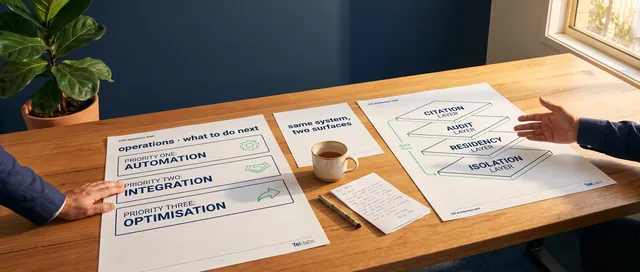
Citation by architecture. Multi-tenant isolation at the database session level. Standard SSO into your identity provider. Agents reading your data in place. A cryptographic audit chain present from the first commit.
Each property is a fact about the data model, not a feature on the roadmap. The sections below describe each in turn.
Every output traces back to its source.
Every output the system produces traces back to the source record it was derived from. Citation is part of the retrieval data model, not a footer the prompt was asked to add. The auditor can follow any claim back to the document, the paragraph, the field. The clinician, the recruiter, the examiner can do the same.
Citation by prompting fails under scrutiny. Citation by architecture does not.
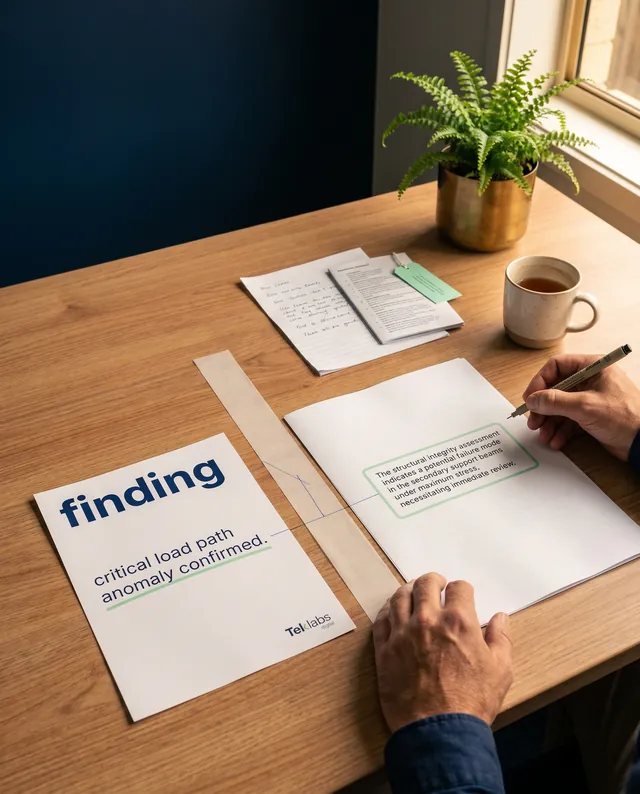
Enforced at the database session level.
Tenant isolation is enforced at the database session level via SQL Server session context interception. Not application-layer filtering. A query that would return another tenant's data does not return data; the database refuses it.
Application-layer isolation is one bug away from a breach. Database-layer isolation is the property of the system itself.
Into your identity provider.
Authentication runs through the client's identity provider via standard SSO patterns. We do not stand up a parallel user directory. Roles are defined per engagement and signed off by the operations leader before production.
Location-aware authorisation is supported where the regulated work requires it.
No data-warehouse build. No migration step.
The system connects to the data estate where the work already lives. The agent reads under tenant-bound credentials and writes back through the same boundary the rest of your applications use.
Signed from the first commit.
The audit chain is cryptographic and present from the first commit. Every action the system takes is logged, signed, and verifiable. The chain survives turnover in the implementation team.
The CISO sign-off is in the architecture diagram, not in a policy document filed alongside it.

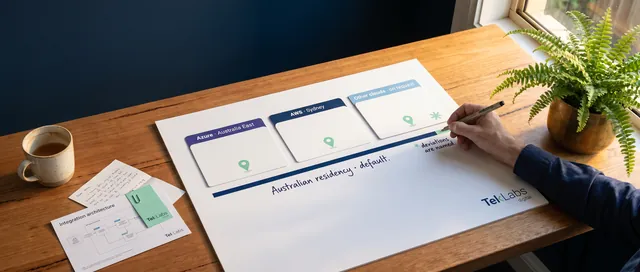
Your cloud. Your region. Australian by default.
The system runs in your cloud and region. Azure, AWS, others on request. Australian residency is the default. Documented exceptions exist where the alternative is real-time voice routing for a specific brand. Deviations are named.
No foreign-hosted AI products by accident. No data flowing to US-resident inference endpoints by surprise.
Designed in. Not retrofitted.
Regulated AI fails in two places. It fails on the floor when staff cannot trust the output. It fails in procurement when the CIO and CISO cannot trust the architecture. Both failure modes are addressable, and both are addressed by the same move: design the trust properties in, do not retrofit them.
The architectural-compliance posture is the package the CIO and CISO need to sign off, ready at first contact. Australian residency, multi-tenant isolation, citation by architecture, cryptographic audit, and procurement-ready security documentation are present from the opening conversation. Not promised at the end of evaluation.
The COO gets a system that ships. The CIO gets a system that survives review. Neither has to argue the other's case.
What this rules out.
The properties are inherited from the engine. Each engagement starts with them already in place.
- We do not retrofit compliance.
- We do not bolt audit on at the end.
- We do not run agentic workloads in foreign data centres for Australian regulated buyers.
- We do not hand the CISO a policy document in place of an architecture diagram.
What the auditor sees.
Three custom agentic AI products in production at a major Australian residential aged-care provider, running under the Aged Care Quality Standards and the Privacy Act 1988. Citation back to source records. Cryptographic audit chain. Multi-tenant isolation at the database session level. Australian residency.
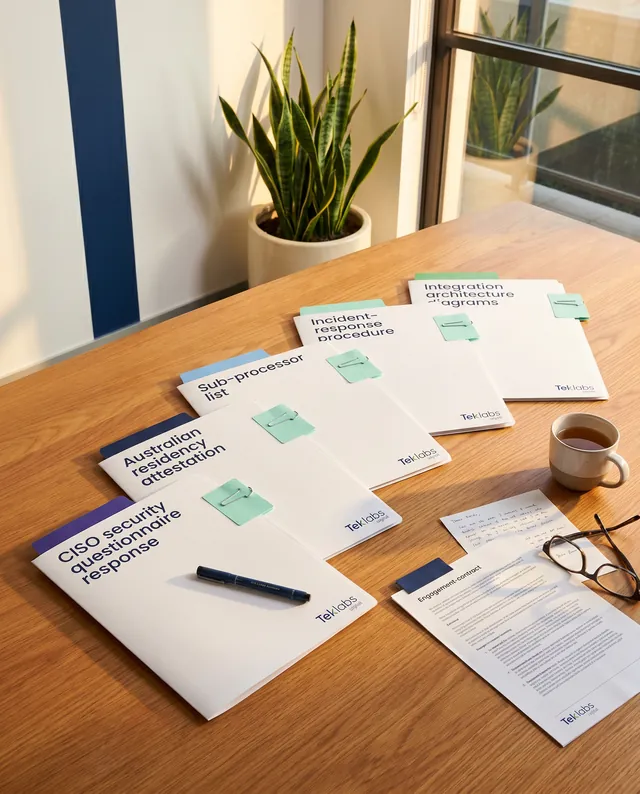
The materials are inventoried, version-controlled, and offered as a package. The CISO security questionnaire responses, residency attestation, incident-response procedure, sub-processor list, and integration architecture diagrams are available on request before the first technical conversation.
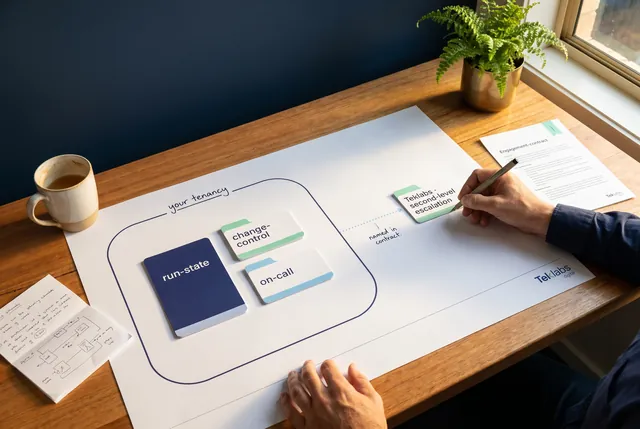
You run production.
Your team operates the system inside your tenancy, on your cloud, under your change-control. Teklabs provides second-level support against a named escalation path, signed off in the engagement contract.
Every solution ships with full technical documentation. Unit tests, integration tests, end-to-end tests, run on every build.
The system performs the work. Your staff sign off on it.
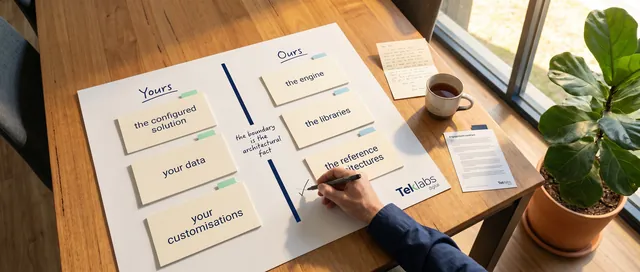
What's yours, what's ours.
The system we configure for your function is yours. Your data is yours. The customisation, the workflows, the surface your staff use: all yours.
The engine underneath is ours. Teklabs.iGentic, Teklabs.Analytics, the library set, the reference architectures: licensed for the engagement, not transferred.
Your IP stays yours. Ours stays ours. On exit, your data is exportable in the formats your estate already uses. The engine licence terminates cleanly.
Yours
- The configured solution
- Your data
- Your customisations
Ours
- Teklabs.iGentic
- Teklabs.Analytics
- The library set
- The reference architectures
We do not build lock-in into the architecture.
A senior call under NDA. Bring your CISO. We will walk the architecture diagram together.